Monday, September 25, 2017

Family Nature Journal:
Option 4, the Family Nature Blog
"Standing there one day, I was transported into another world. I  watched native trout and underwater viewing window. Above and below were muskrats and local birds, and I was told that deer and even an occasional elk wander into the viewing area. I was struck by a thought and question: first this room and its living view beats TV; and second, what if a neighborhood were structured around a rehabilitated wildlife habitat?"
        – Richard Louv, from "Creating Every day Eden, Backyard Revolution"


As we begin a more explicit attempt at re-naturing our lives by finding good daily practices and imagining our homes as nature centers, one thing becomes very obviously clear: there are a few common tensions that compete for our time in these projects.  Some of these tensions are bound to be exclusive to each family's life style, work schedule, extracurriculars, social, etc; but one that we will all likely have in common is the great balancing act between "screen time and green time."  A very eye-opening article from 2010 NYT was titled, "If your kids are awake, they are probably online." The article went on to make a point that for many of us, especially kids, usually some form of digital media is turned on and being absorbed throughout the day, as a kind of built-in companion, if you will. It may be music, it may be the phone, internet, TV, but taken as a whole it surrounds us and becomes nearly visible, a similar role, one can imagine, that nature used to play in our lives. The true trick then in a modern environment is first to recognize this media surrounding, and then begin the journey of re-naturing some of that time, for the sake of balance and well-being.  Louv and others involved in human restoration have spent a lot of time trying to provide us with as many examples and tools for doing this as they can find.  Certainly creating one's own home and yard as a newfound source of 'nature time' is a great start.  But to keep the project alive, and to keep it engaging and realistic in terms of interest, we need specific practices and modes of creation.

I have found that placing my various interests in nature, food and travel into a blog is a great way to keep these projects low pressure, low profile, but also accountable.  The nature blog is a few things at once: first, ideally, the blog post is in reaction to some time spent outside, doing something, observing something, thinking, researching, running around outside, or whatever.  Whatever style the blog post takes hardly matters – some nature writers thrive in relating nothing more than descriptive journal entries, others scientific observations, others outdoor adventures written in narrative form, even poetry. To keep a blog alive and restorative, so to speak, it needs to release from other standards of perfection or deadline. Blog posts are thoughts in action, they are hopefully loose, and don't necessarily need to be edited. In other words, they can be fun and kids will like them.

The second obvious point to make about the potential family nature blog is that they are indeed screen time and visually oriented, but a 'nature deal' I am willing to make. The set up for the blog entry is natural discovery. The blog format also allows for personally taken photographs of nature or even self-created art!  Use a quote from a nature writer for inspiration...the blog post might include reading!  All of this creates a pleasing sense of not only accomplishment, but it is a permanent testimony to experience and can be archived to view for yourselves, but it also, by its very definition of being a blog, is a sharable contribution.  For grandma to be able to watch the family 'nature journey' from afar is bound to be special for all participants.  If the blog 'practice' gained momentum and stuck as a ritual, is it possible that kids could share among themselves their own nature blogs? In the realm and scheme of things, I have to say I would be far more tickled by the prospect of a nature blog friendship than a Facebook friendship.  One is educational, fun, experiential, and moving toward the direction of a wholistic goal; the other a short, clipped advertisement for self that includes virtually no substance.  One seems permanent, alive and restorative; the other passing, artificial, and ultimately energy depleting.


Option 4: Create your own family blog site.  Blogger or Word Press offers very simple free blog services that work seamlessly well.  The process might take 20 minutes, maybe an hour if the design of the page is really important. Experiment with a beginning posting structure that can be used over and over again to start, then let your own form take shape over time.  I like to bring in a personal photo of nature, then write a quote of inspiration from a nature writer next to the picture.  Then I begin my own writing, whatever the topic might be. The easiest writing to start with is the simple descriptive journal entry. "This afternoon, we (I) decided to walk around the block only looking at the front yard gardens. This time of year we saw mostly ________. The sky above was __________ I remember one day thinking what it would be like to live near water....the last Monarch of the season flitted past. Monarchs are amazing look like stained glass in flight. Without looking as much at the houses and more at just the nature, I began to realize we lived inside a forest....."

Any of these impressions can lead to not only more writing (patience in writing literally takes time and practice!) but to quick research projects, art, knowledge.  When we quickly evaluate this entire process, all for the sake of colorful, artful, thoughtful, blog page, in comparison to virtually any form of media consumption, they don't even compare.  Over time, we actually begin to intuitively come to grips with this difference and will become more attractive to the restorative process of creating, than the depleting process of absorbing. At the end of the first blog post, plan for the next one. This is thinking like a writer and researcher – what do I create next? Parents may need to set out a sticky note reminder for that day's 'outdoor adventure' and blog entry. Remember that it can be edited at any time after publication if desired.




Sunday, September 24, 2017

Wingra Views
"...but the
    reaper cannot
       separate them out there they

are in the story of his life
    bright random useless
       year after year..."
         
   – Mary Oliver, from "Morning Glories"


Even the Buckthorn berry,
   considered a menace along the shore trail
       perfect little beads

little globules of the perfect red
    whose curved sides
         bob but little, stationary

reflects the slivers of sunshine
    making it through the lush
       leaf of cottonwoods

and hold their space as if defiance.
   That is the way of all that is living.
       That choiceless perfection as is.

Below, as if in unison, autumn leaves
    create for the eye –
        lens of the earth –

a pattern of color
    and fiber and nutrient
        that does not think but will

eventually reach the lake
    from underneath along rootlines
         where my footmarks will never reach


Friday, September 22, 2017


"Sunlight like honey this morning,
and a stiff wind spreading it smoothly
over the bluestem." – Ted Kooser, from Winter Morning Walks


september 21


Slight breeze and cool early morning.


The bay at Black River mostly flat as glass
but for one long arm of deep ripples
that curves across the surface
from point to point at the entrance
like an arm claiming poker chips.
When I open the sliding door I notice
the chortle of songbirds has left
as if a transaction had taken place
late last night under the cover of moonlight.
The airwaves of the auditorium have been given
to the slight flapping of the aspen leaves.
A bald eagle watches over the bay
from an oak limb as if guarding
the rising cricket hum.


Thursday, September 21, 2017

Family Nature Journal
Option 3

"By September, the day breaks with little help from birds. A song sparrow may give a single half-hearted song, a woodcock may twitter overhead en route to his daytime thicket, a barred owl may terminate the night's argument with one last wavering call, but few other birds have anything to say or sing about.
It is some, but not all, of these misty autumn daybreaks that one may hear the chorus of the quail."  – Aldo Leopold, from "The Choral Copse"


For those interested in the outdoor learning movement, so much energy obviously needs to be placed in continuing to provide positive engagement, slow time, and activities built around a hopefully newfound daily connection with nature.  But it is also important sometimes to take a wide lens look at that list of things that seem to prevent us from turning our own homes to nature centers.  Some obvious preventers are simply time and energy, a busy schedule and sometimes nothing more than a lack of interest.  Another that comes up, especially as we begin to create our own curriculums, is that there is always a question whether we are really enough of naturalists ourselves? Are we experts or just novices? And if just novices, are we really qualified to begin this project of prioritizing "green time over screen time?" The answer is absolutely, without a doubt, yes.  To start with a very simple human argument, we all are born with the right to a connection with nature, whatever that comes to look like.  As mentioned in first Family Journal post, this project is going to take as many shapes as there are families. Some families are musical, others athletic, some in business, some in non-profit. There are entry points to outdoor


learning for every avenue of interest imaginable. Any trained naturalist will hopefully tell you that even though they have expertise in a particular field or two, or that they might have a strong and broad knowledge of the outdoors, the truth is, there is no way to be an expert in all things natural. And that this information and training is not exclusive to anyone.  If we were commissioned to write scholarly articles, or create lab documents then, yes, we need expertise. What we are going for instead is something far more accessible and familial: time spent outside, seeing natural images instead of artificial, and re-learning about a world outside of our making, one that we are significantly a part of.  In a way, the  outdoor learning movement will come to mean learning about oneself more wholly, more balanced, as a result of getting to know reality again, the river, the park, the bird, the bat, the sound of the wind, the unusual flying pattern of the Monarch. Those things are not something separate from us and only known by an expert. In fact, they are you and you are them. This understanding needs practices and time.

Family Journal Option 3: Become your own expert.  Writing is a powerful tool for understanding things. We have thoughts we carry around, but they are often fleeting and hard to grasp, much like the butterfly mentioned above. Writing is a sort of test of what you really think.  Very short pieces of writing, one sentence, a tweet, etc., only capture the kind of short thoughts we carry around with us that are fleeting and untested.  If we only stick with the short responses, unfortunately we can never really come to know what we think. To write a page about something can seem an insurmountable task sometimes, especially if we haven't done it. But the rules are that everyone can write, everyone can think, and everyone has a right to a connection with nature. These are all permission slips to becoming an expert on something natural.

Take a 20 minute walk around the block, to the park, to the close hiking trail, and take either mental notes or written notes on three things that seem to stand out in nature. What are your impressions? What do you already know about this tree, this bird, this blade of grass, this prairie flower? If you don't know, guess for now. You can research later.  Sit inside and write one page, as an expert, about one of these three subjects. Use Leopold's line, "By September, the day breaks with little help from birds. A song sparrow may give a single half-hearted song, a woodcock may twitter overhead en route to his daytime thicket," as inspiration, placing yourself within your month, your day, and any natural pattern you can think of.  Don't stop to think too much -- there is no expert watching. Try this everyday for a week.


Wednesday, September 20, 2017

Family Nature Journal
Option 2

"Yet, nature does not have to remain 'out there.' It is right here, beyond the window, just waiting to be noticed. The squirrel scrambling along the phone wire; gulls circling high overhead; silhouettes of trees; cloud formations; the chance butterfly on your porch geranium..." – Clare Walker Leslie, Drawn to Nature


Your home is your nature center.  This might take some getting used to and an imaginative leap or two, but it seems important to not have to wait for 'some other time' to get outside.  If there is one small problem with the outdoor learning movement as it is found in institutions, it might be that it has worked to overcompensate the lack of outdoor exposure by turning outdoor experience into something overly rigorous and task oriented, a school lesson with a list of outcomes. As outdoor learning becomes more comfortable with itself at all levels, and as administrative oversight begins to see that sometimes nothing is something, it seems it will be natural to see that mere unregulated "green time is better than screen time," and that simple time spent in observation, recognition, imagination, and wonder will fill in many of the missing spots in childrens' (and parents!) lives. But the scene does need to be set. If we transfer over to our own homes some of the things we tend to see and experience at nature centers and outdoor gardens, we can begin to see that every day at home is a potential nature center experience. When we go to the nature center around our cities there are a few things that we are introduced to immediately: usually the natural beauty of the surroundings; we are introduced to the history of the 'place;' and then we might be led on a tour around a forest or garden, asked to see certain things and take note of them. Activities might follow.  Much of this can be duplicated on our city or rural streets, it just takes a new vision to make the opportunity ever-present.

For example, at the UW Arboretum, we immediately are introduced to its long history and its pioneers of prairie, forest and marsh restoration. We learn that the land in this area had been prairie oak savannah pre-settlement, then turned to farmlands, which created disruption, which transformed the landscape. The idea behind restoration is to try to reintroduce native species and pull back non native species, so that there is a harmony again between land, growth and its care.  Take a little bit of time read about the history of your city and neighborhood.  There are always stories about founders,


development and allotted green spaces. Begin to think of and talk about your own home as part of this fabric that had been created on top of a previous landscape.  As you walk around the neighborhood, not only point out as many plants as possible, but think of lawns and gardens as restorations.  Call them that if it helps.  Along the edges of Lake Monona there are many patches of milkweed. Why is it a good idea to make sure all the milkweed doesn't get mowed? They are the sole source of Monarch butterfly habitat. Where you see milkweed, you may see an egg, an instar, eventually a full butterfly.  Once the story is revealed, the imagination begins to see that the city street is not about concrete first and nature just grows in around the edges, but the other way around: it is the lake, woods and parks first; houses came afterwards, beautiful, but also a change in the landscape, and we can become land restorationists ourselves, every day. The squirrel now has new meaning. The shade trees are native habitat. Where you learn these things is your own nature center, your home.

Family Nature Journal Option 2: Briefly talk about what your neighborhood began as. For many, it was Native American first, then settlement, then city, and hopefully a city plan that included parks and green spaces. Who are the parks named after?  Outside, take a water color postcard and draw on its front a sign of a park and write journal notes pointing out the nature around it, any observations that are happening around it, birds, squirrels, shadows, sky, etc.  Flip the card over and write about "why my house is a nature center. If I was in charge of taking care of the park, I would..."


Tuesday, September 19, 2017

Family Nature Journal:
A Curriculum

"You may say you have no nature around you where you live. Or perhaps you don't have time to go looking for nature. Or maybe you aren't sure where to begin. I think one easy and fun way to start, no matter where you live, is to simply observe the sky above. It is always there." – Clare Walker Leslie, from Drawn to Nature


After attending a very enlightening information session put on by Sustain Dane's Outdoor Learning Network, one thing that became clear, as it has in the past, is that people need to connect with nature. But how we do that is bound to be as varying and dynamic as people themselves, which is to say infinitely. In a way then we are all potential curriculum builders for our own nature projects, our hikes, our gardening, our hunting and fishing, our learning, our art and our wonder.  The Family Nature Journal: A Curriculum, is meant to be a project in motion, a set of thoughts and observations that might have just as much a tendency to look backwards as forwards, and, if fortunate, always looking right now directly up into the sky, for that would mean that today has been a good day, somewhere, somehow, outside.

We are finally now in the full-on evidence stage of realizing that people, no doubt kids especially, need nature connection.  There is no need to try to go through the entirety of all that in this blog slot – in a way, it is complete common sense once we give ourselves even a moment to think about it – but it is important it seems to realize that in order for that connection to happen, it might not necessarily happen for free, but in many cases needs to be sought out intentionally, even earned.  We practice many things to become good at: reading, writing, arithmetic, music, sports, video games.  It shouldn't  surprise us at all that a connection to nature has similarities. To purposefully prompt children to get outside and take a walk or check out the ducks at the park, well, it takes some prompting and it takes sometimes some good but firm arguments for those days when the response is "no way." To consider the simple measure of a rule that goes something like this, "one hour of screen equals one hour outside," can only work if the second half of the equation has follow through day in and day out. It's very possible, hopefully likely, that once this system becomes part of daily life, the child will in fact begin to seek out that hour on their own. I have seen it happen with my own eyes.

The family nature journal will need an initial prompting, a commitment. A simple daily check off sheet could be a start, art projects, writing projects, or even a family centered blog.  If none of this practical concrete 'achievement' is necessary, that is great in a way, because it means all it takes is some verbal prompting and that is that. But for other learners and 'experiencers,' something created and concrete might be just the thing.  A great and simple start is right where Clare Walker Leslie


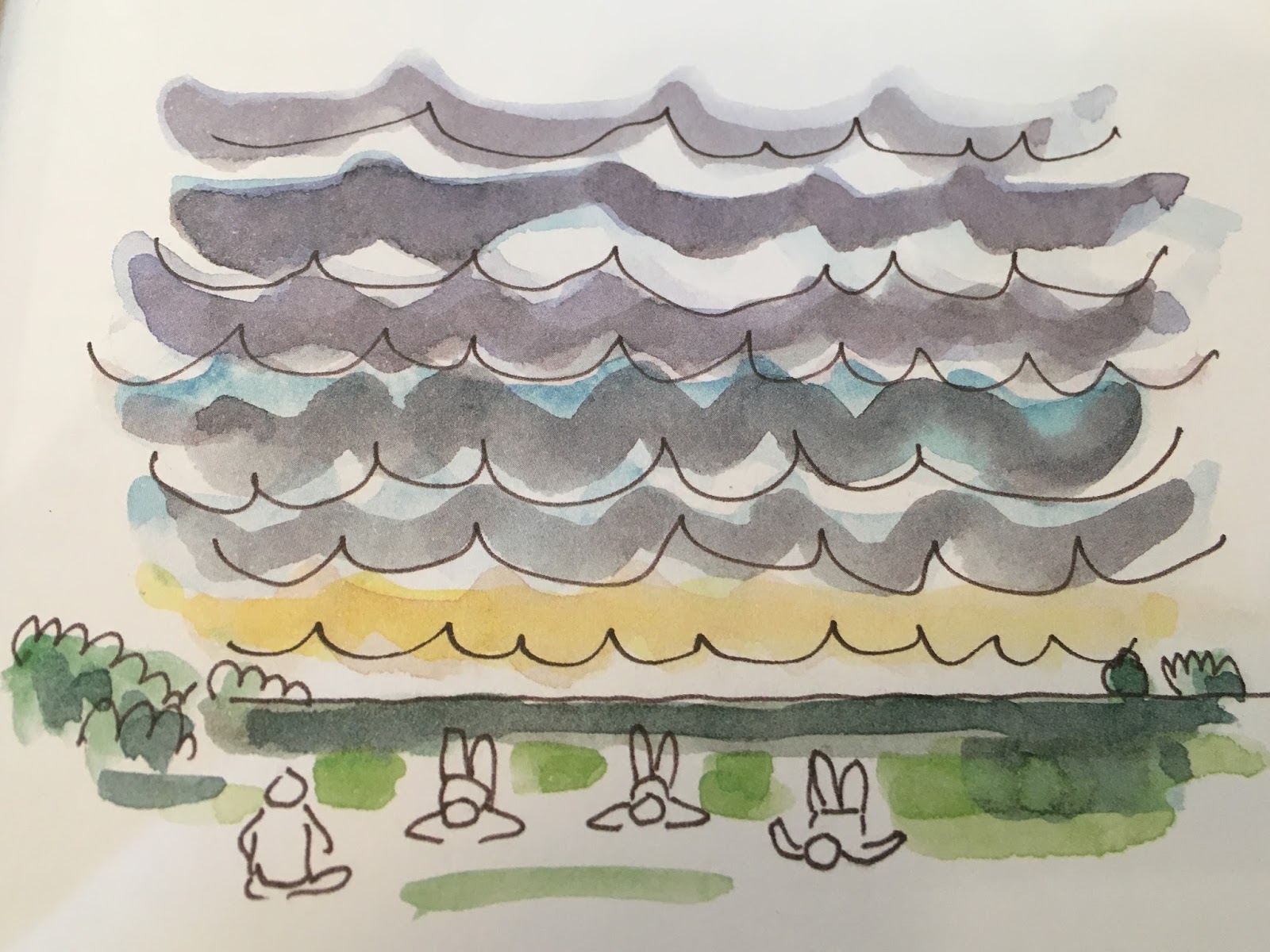
begins her wonderful book of journaling where she takes down the the note, "I began noticing the sky when out in Minnesota teaching students to observe local land. We were on our backs watching billowing rolls of clouds filling the entire sky. No one knew what they were. Later, we were informed they were mammatus clouds – clouds of high disturbance."


"Clouds of high disturbance" is a writing instructor's dream and one that could easily become a stop-off point for a poem or any other kind of written observation. The drawing here is simple and engaging (never as easy as it looks when it comes from a great artist). Free and easy is the key to begin.  I recently had the opportunity to take a nature art journaling course at the UW Arboretum and was very quickly reminded that my ambition simply didn't match up to my ability and I had to scale back my attempts at drawing nature from intricate and accurate to light and whimsical. In twenty minutes I could create a postcard size drawing from nature and was very satisfied with the low pressure process of pencil or watercolors. The key is, the real point of entry, is that the 20 minute drawing is time spent not only outside, but time of connection that easily rivals (and we hope surpasses) anything experienced on screen or indoors. Replacing artificial images with natural images is really an enormous part of the outdoor learning movement.

Curriculum option 1: buy some water color postcards at the art store, along with whatever art tools necessary, and draw a 20 minute picture from nature on the front. On the back, write a journal entry. If an interesting phrase pops up, write a poem of any length along the side or at the bottom. Hand it to a parent or send it to a relative.


Monday, September 18, 2017

"...In the woods
A north wind plays. Chaotic crickets
Call from an ancient moat. Lingering
Sunlight illuminates
A desolate terrance."
       – Huai Ku, "Living on the Plain in Early Autumn"


Don't have far to go.
The courtyard is aflame by noon sunlight.
The King Tut Grass arches
over the terra cotta art.

As I sit in silence at rectangle of sunlight
I want to hear only two things:
the cicadas chanting in the trees
that overlook the Yahara
and the crow call
that roves the streets like wind itself.

You said you wished the world
would be quiet.
I wonder if we stopped the spinning wheels
if the cicada song
would reign.