
Tuesday, October 25, 2016

What's in Boulder?


Mountain dreams more often than not become reality in this little corner of the front range Rockies.  A sort of beer meets trail ethic has taken shape in Boulder since the very beginning of the microbrew


revolution that is still being carved out of the culture as we speak.  Many stories begin by the chemistry major tinkering with the bold concoction of yeast and hops in a single vat out in the garage; stories now unfold in which the micro connoisseur hand picks local ingredients only for small


batches of Saisons that are distributed small scale, but capture a region.  In Boulder, the vast sky is the limit.  For every hiker who has ever mentioned off-handedly that, as they cross over the summit of a long and arduous alpine trail, that they fantasize that this would be a perfect location for a small brewery – out in the woods itself, the beer drawing on not only the surrounding flavors, but that


utterly chill moment when horizons merge to happy hour, well, Upslope Brewery has done it.  There is such a thing as the backcountry "pop up" tap. That is to say, not a trail mirage, but look, along that trail that you have been hiking up to 8,000 feet to Vance's Cabin, a member rental of the 10th


mountain division, has an Upslope makeshift tap shack offering you one free beer (introducing Fresh Hop IPA), and then offering purchase of only two more cans of any kind (they do want hikers to have


the wherewithal to get back "downslope."  Across the trail, one would hope, someday anyway, that the pop-up gourmet pub food bistro will someday devise a way to lure those beer drinkers over a flatiron rock for an Alpine tapas or two.



Monday, October 24, 2016

On Monona

"I feel the sky, the prairies vast – I feel the mighty northern lakes,
I feel the ocean and the forest – somehow I feel the globe itself swift-swimming in space;" Whitman, from "To the Sun-Set Breeze"


Morning, early, before the great rise of orange
over the bulbous blue chatter of the lake has begun,
the fathers stand at the corner of Rutledge,
hands and elbows folded against the lake wind,
shuffling their children off through the rustle
of golden leaves in between cars and onto the bus.
Behind, through the short back street, a sliver
of the coming cold steel blue of the lake,
one seagull alarmed and padding the sky above by wings;
as we drive by, careful, in and out of the cars,
we know the morning and its own careful hues.
The lights blinking outlining the windows of the bus,
roars off into the long hours of the day,
away, away, school across the street from the Yahara
      they go
the mind of the river with them, blessed.


Sunday, October 23, 2016

Scenes from the Bridge

"Shot gold, maroon and violet, dazzling silver, emerald, fawn,
The earth's whole amplitude and Nature's multiform power consign'd for once to colors..." Whitman, "A Prairie Sunset"


Each man, woman, child, – clothed to autumn, cool wind –
a leaf of color themselves; green turning golden, flash...
look at how they swim across the thinning grass bent
over the handles of rolling bikes that will not give in.
How the concrete is warm-blanketed as they pass over
the bridge then stop to admire the phosphorescence,
the ducks below shaking off droplets from cooling wings.
Lift up the scene to imagination and here seasons flow
upwards, from shaded rooms to the clouds we can't live in.

Friday, October 21, 2016

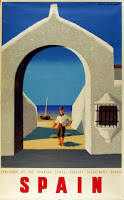
Sketches from Spain
Pintxos Trail

"When I had done breakfasting the squire gave me a note addressed to John Silver, at the sign of the Spy-glass, and told me I should easily find the place by following the line of the docks and keeping a bright lookout for a little tavern with a large brass telescope for sign." Stevenson, Treasure Island


One only has to walk up from the Bahia de la Concha Bay to the Alamada del Boulevard to get firmly lost in the Pintxos Trail, said to be the densest quarter of such bars and eateries in the world.  The locals here do not waken again until the night time, dining as late as nine or ten at night, families or


friends, and following the clusters of crowds from Basque bar to bar, sampling and seeing friends.  It is said that this habit of the night for the Spanish might come from several things – outwardly friendly, their sociability might come from the many hours spent out under a warm sun where days


are long and that to make that day endurable there must be several times to break and dabble in whatever produce is available, most likely from the farm.  There is also the idea, as Hemingway described in his definitive book on bullfighting in Spain, Death in the Afternoon, that it was the heat that had descended on and stayed inside the cities at night, that made sleep a silly prospect.  The coolness does not come until nearer sunrise, when the locals can than, finally, close their eyes to get some peace.  It is not uncommon to follow the Pintxos Trail, along de Agosto and Narrica, all the


way through the night, purposefully meeting friends for meetings past midnight and finishing at the disco as the sunrise threatens off the horizon, all to the end of planning how this next day of work and sea and heat might play again.  One might stop at La Vina tapas (pintxos) not only for its own array of snacks such as Canutillo de queso y anchoa or the Croqueta de jamon, but most famously the Tarta de Queso, or cheesecake, to finish off the digestion for the night.  There would be at this moment, perhaps two in the morning for the common tourist, where there would be a certain quality of the fantastic as one made the way back to a hotel, standing there lit against the shimmer of the night sea,


that could only be rivaled by the books.  Ancient ramparts, imperfect now in their execution of line, crumbling after hundreds of years of the constant erosion of sunbake and sea moisture, against the bright lights of sets of these tapas bars, all the while a wild vast Atlantic looming off in the background, one of the most common sights of ship fleets, privateers and buccaneers ever known to history.  We could imagine what it might be like to be a midshipman on any such ancient Galleon of old, paddling into this magnificent shore by moonlight, looking up into the candle-lit tavern and know that the treasures you hold inside the foredeck cabin was safe for the night against the approaching marauders from the north or south or both.


Thursday, October 20, 2016

Sketches from Spain
"At Valencia too, when it is hottest, you can eat down at the beach for a peseta or two pesetas at one of the eating pavilions where they will serve you beer and shrimps and a paella of rice, tomato, sweet peppers, saffron and good seafood, snails, crawfish, small fish, little eels, all cooked together in a saffron-colored mound. You can get this with a bottle of local wine for two pesetas and the children will go by barelegged on the beach and there is a thatched roof over the pavilion, the sand cool under your feet, the sea with the fishermen sitting in the cool of the evening in the black felucca rigged boats that you can see..." Hemingway, from Death in the Afternoon


There would be the hours in the afternoon off the beaches at San Sebastian that only the simplest little dish would make do against the beating of the Biscay Bay sun.  You might as easily see the farmers at the outskirts of town, where the grand crescent of the Sebastian Bay is barely visible, out at the foothills, waves in the distance crashing 


like tips of long sacks of fine jewels, that the man might bring to a fire a hand full of onions, zucchini, tomatoes and peppers for the Pisto Manchego.  This was a dish that originally came 

from the Castilian heartland of La Mancha, the same famed quarters of Don Quixote.  The farmers here took the cooling of the Manchego quite seriously, had formed clubs that would meet as frequently as each week, and hunker down onto the cobblestones of the main squares with their days retrieval, peel the tomatoes, toss it in a pan with a 


slip of sugar and salt until darkened as they sauteed onions along the side.  Add bell peppers and finally the zucchini, simply stir to coat, adding the special Spanish seasoning of paprika after 20 minutes of simmering.  The others of the group would wait out in the afternoon sun for the familiar smells of the sweetened vegetables to mingle and would know, well before the cook would know the time, when it was ready for serving into simple earthenware bowls.  If it was a special day and the fish was being caught off the quaint waters of the Bay of Biscay, and if the farmers had sewn and harvested recently, there might be a Navarran red to swish around the mouth for the hour or two of the siesta.  After so many rounds of the Manchego, it would be said, at later quiet hours, that the Spanish sunshine tasted something like stew and all were quite certain that their eyes would light up at first taste. 


Wednesday, October 19, 2016

On the Yahara A-Z


V.

Vegetation up close from the Lake Wingra Boardwalk Extension Project.  Some of the greatest natural gems in and around Madison are right inside the city itself. Access to natural resources had


been a priority of Madisonians since the conception of the Pleasure Drive organization began setting aside green space before that notion had become anything close to fashionable.  Olbrich Gardens formed as a means for sharing a natural habitat with those might not otherwise get out into nature as a result of long work days spent inside.  The Arboretum, once a farm, was not carried forward as a space for more factories, but was set aside as a sight of natural beauty and shared for the purposes of education.  With these city foundations in mind, the traveler never knows where the next investment

in green might come.  Parks line the lakes seemingly every several blocks. Trails and bike paths assert themselves where other cities might add asphalt instead.  So it should come as no real surprise (although it still did) that behind the campus at Edgewood Schools Campus a spectacular little boardwalk trail leads from the front stoop of the Mazzuchelli Biological Station down into the depths of the Wingra Marsh, allowing the thoughtful walker to see no more than inches away the very thickset understory of a living marsh and shoreline habitat.  We found it by accident as asimple walk after school along what is called the natural pleasure drive trail located directly behind the backyards


of Edgewood.  An environmentally sustainable building, the Mazzachulli Center, stands at a shallow ridge overlooking Lake Wingra, and there, out before it, a system of boardwalk trails students use for recreation and classroom driven biological research into the secrets of wetland functioning, including the advance of invasive species and the natural service of marshland filtering.


Tuesday, October 18, 2016


"–but most of all, or far or near, the wind–through the high tree -tops, or through low bushes, laving one's face and hands so gently, this balmy-bright noon, the coolest for a long time..." – Whitman, from "Distant Sounds"


10/18

Broad stroke of a lake without boats but a watercolor, bubbling, wave upon wave, barely gulping inward toward shore from the low blowing wind, and holds then carries the oranges and yellows from the maples and oaks.  The bridges are sturdy as ever against the change of seasons, old ramparts and leave their own arching shadows over the melting of the autumn colors.  A sky hawk had just circled from the leap off of a great falling oak until he had seen the glimmer of a small fish in the shallows then collapsed its wings and dove down into the water quickly stabbing.  Only the far off clinking of some jackhammer at the capitol competes with this early noon hour quiet.  Foot traffic, jogging and mothers behind strollers, the man in the leaf pile grabbing with gloves, are nothing but slight motion and no sound.  Men and women at the back sides of their lakeside houses reading books from balconies, the pages turning only as loud as the last wave rolling over the quarried stone at the tip of the Yahara.